The Magic of Mall-chitecture (Mall Architecture Nostalgia!)
“Cause we were like the mall before the internet — it was the one place to be.”
Taylor Swift, “Coney Island”1
Though some of Taylor’s pop culture lyric references make me cringe, I do love this one. Like many high/low cultural aesthetes of a certain age, I’m fascinated by the many images of abandoned malls that have proliferated over the past decade.
Most recently, it was an Atlas Obscura piece titled “The Life and Death of the American Mall” that got me thinking. As author Matthew Christopher writes:
Malls have become a part of the modern collective unconscious, through both the haze of half-buried memories of any American over the age of 20 and their ubiquity in popular media.
This is one of those “hinge” moments I seem to have been born at exactly the right time to experience: the transition of malls from “sparkling palaces of wonder and delight,” as Christopher calls them, to dated relics and now morphing into nostalgic touchpoints — even for the malls that still exist.
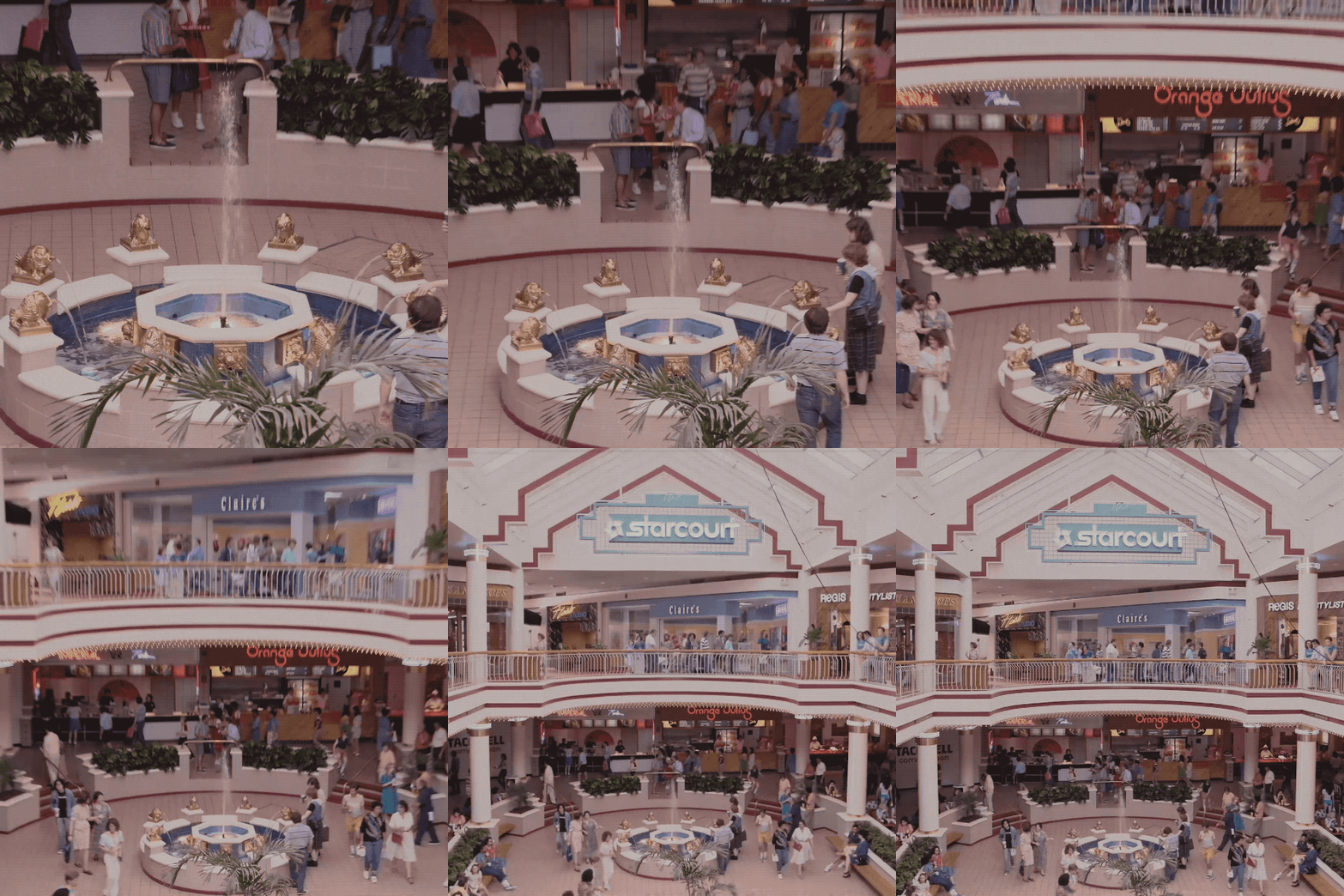
The mall architecture of my formative years
Western Pennsylvania seems to me now as an area rich in mall-chitecture. For me, it wasn’t so much the stores in the malls that entranced me as it was as the architecture of each one: collectively a fantasy to my kid brain, but individually beautiful and uniquely identifiable.
The Richland Mall, my first mall, had an undulating contrast terrazzo floor that mirrored the ceiling lighting pattern and which I always followed with my eyes we walked through the concourse. As an adult, I’m a terrazzo superfan, and it might be this mall’s influence that made it so.
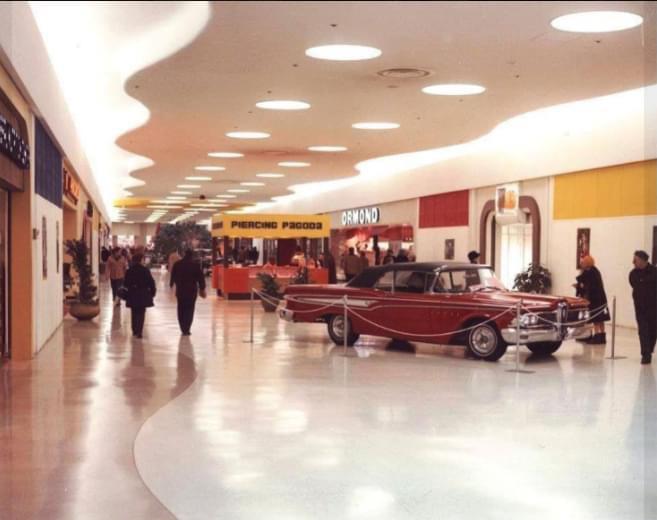
Here’s a photo from a Reddit thread of the Richland Mall’s unique ceiling and floor patterns dated to 1974. According to the title caption, this was the concourse leading to KMart, one of our family’s most frequently-visited stores — so I would have walked this hallway many, many times as a kid.
Moving west toward Pittsburgh, the Greengate Mall’s food court, AKA “Picnic at the Gate,” felt so magical to me as a pre-teen.2 Its area was delineated by faux trees festooned with tiny white lights and a central fountain done up in the ‘80s trendy shade of dusty teal.
The food court was clearly the most elegant place to grab a table and splurge on a tuna sub on a Friday night. This is the best picture I could find and it truly does not do the spot justice — but check out the Montgomery Ward sign in the background!

Closer to Pittsburgh, the Monroeville Mall (famous for being the setting of George Romero’s Dawn of the Dead) had the most amazing superfluously decorative bridges crossing over pond- and creek-like water features. Even as someone who could never bring herself to watch a horror movie, the bridges fascinated me as an architectural element every time we’d visit this mall.
And it’s because of Dawn of the Dead that one of the bridges was preserved in Pittsburgh’s Heinz History Center after the Monroeville Mall was renovated (yet again) in 2015. A win for mall-chitecture!3
I say (yet again) because it seems like every mall built in the late ‘60s or ‘70s started getting makeovers in the 1990s. And as these spaces were brightened up, they became successively blander and stripped of some of their more distinctive architectural or decorative features.
There’s no magic in modern mall-chitecture for me.
Now I feel like malls or “town centers” or “shopping districts” or whatever the developers are calling them these days are cookie cutter templates of each other. Blinding white walls and neutral tile floors, faux midcentury seating hubs, and maybe a hint of metal accents — the liveliness seems to have been stripped out of the mall’s very core.
However, much like You’ve Got Mail now gives me nostalgia for the multilevel behemoths of Barnes & Noble and Tower Records of the Upper West Side4 in the mid-2000s, will these bland mall designs of the 21st century be looked at with fondness in a few decades?
As malls themselves continue to be torn down and replaced by mixed-use developments or clusters of big-box stores, this is a distinct possibility. We may also be even more nostalgic for the human, tactile shopping component that these spaces gave us.
My beloved mall-chitecture was quirky and individual, with a human designer’s imprint. I may not feel as welcome or seen by our current mall spaces and shopping experiences, but it still feels like more of an exploratory adventure than buying stuff online.
- Ironically, something Taylor herself never experienced, as she turned 13 on December 13, 2002. ↩︎
- Also ironically, even though I felt like Greengate was the “fancier” mall, I spent most of my time at Westmoreland Mall closer to my house — a mall so bland even then that I cannot recall a single architectural detail. I needed this photo of the central atrium elevator to jog my memory. ↩︎
- As Western PA once was rife with excellent malls, it continues to be a hotspot for amazing cultural institutions, of which the Heinz History Center is one. Make it a must-see on your next Pittsburgh trip! ↩︎
- These megastore chains, I suppose, could be considered as micro-department stores of their day. Which is a particular kind of nostalgia in itself. ↩︎

TIP YOUR TOUR GUIDE
Like what you’re reading here?
I choose to keep my site ad-free and sponsorship-free, so please consider showing your appreciation by leaving a few dollars in my tip jar.