
The 5 Human Design Energy Types as Seen in Hamilton
Once you start learning about Human Design, you start seeing it everywhere. Talking to your friends and coworkers and wondering… are they a 4 line? I bet they’re a Projector. They seem like a Caves environment too.
I do it a lot while watching documentaries (Bruce Springsteen and Martha Stewart are both Manifestors, FYI) and now I’m even doing it with fictional…ish people too.
While I’m like 99 percent certain that Lin-Manuel Miranda didn’t create the main characters in Hamilton based on Human Design archetypes, I now can’t un-see the idea that they naturally correspond to each of the five energy types in Human Design.
And it feels like an awesome educational opportunity to explain more about Human Design to those who might be curious.
What are Human Design Energy Types?
Your energy type (or just simply type) is the most top-level, big-tent, basic piece of the Human Design puzzle. We all fall into one of five different types: Manifestor, Generator, Manifesting Generator, Projector, and Reflector. And these types tell us how our energy works best and how we move most easily through the world — how our operating system is meant to function most easily and efficiently.
When we’re feeling like things are flowing and coming easily to us, when we have energy to take on projects we’re excited about, we’re in alignment with our energy type. If we’re feeling like things are exhausting, harder than they “should” be, we’re probably not following the strategy that works for our type.
The point is that what works well for one person (me as a Manifesting Generator, for example) could be completely disastrous for another person (my husband as a Projector), so Human Design shows us the direction that feels most natural for us individually.
Now let’s take these energy types and superimpose them onto five main characters from Hamilton so you can understand this more fully.
And if you want to know your personal type, strategy, and more, let’s schedule a Human Design Download session!
Remember: These descriptions are big-picture interpretations based on the characterizations of fictionalized historical figures in the musical Hamilton. They are not based on real-life birth charts for any of the real-life counterparts depicted here.
Alexander Hamilton: The Manifestor
If there’s a defining personality characteristic about Hamilton, it’s that he sees what he wants in life and unapologetically acts on his desires. That’s being a Manifestor to a T.
Manifestors are the only Human Design energy type that can take action without waiting for any external signal. They can just do it: spark the flame, run with their ideas, see what happens!
Manifestors can sometimes feel like they rub people the wrong way, because their aura is not meant to attract everyone like Generator types do. They’re here to put the ideas in motion, and let those who vibe with them help bring those ideas to fruition.

And that’s the key to a Manifestor’s life strategy: to inform. It’s not asking anyone’s permission, but simply letting people know the direction in which you’re headed. And Hamilton is informing all over the place: writing his way out, telling Washington he needs a right-hand man, going ham on the Federalist Papers, creating the American financial system, etc. etc.
And the moment Hamilton does something shady and gets caught, he realizes, “oh, I need to inform everyone of what was really going on!” and voila, the Reynolds Pamphlet.
Personally, I think Hamilton is not the most embodied Manifestor, because he spends a lot of time in his unaligned state of anger. He’s also likely dealing with burnout, because, again, the man is non-stop and can’t take a break to rest. Does he ever feel a Manifestor’s signature of peace? Maybe in the last few moments of his life when the bullet is coming his way.
Eliza Hamilton: The Generator
Making up more than a third of the population, Generators are the steady batteries that keep us all running. When a Generator fixes themselves on a passion project, they can work and work and work on it as long as it’s feeling good to them. The minute a Generator doesn’t feel energized by what they’re doing, however, it’s time to stop and change things up.
The decision-making strategy of a Generator is to respond — which is always happening. When opportunities, experiences, people, anything at all comes into a Generator’s orbit, they listen to that internal YES! that tells them move forward or the NO! that tells them this isn’t the right fit.
Eliza is committed and supportive, pouring herself into the work of being Hamilton’s domestic partner. Hamilton sees her magnetic resourcefulness, and she feels their partnership is meaningful and satisfying — a Generator’s signature state of alignment.

But the minute she’s betrayed by her husband, she switches the narrative. She stops. She says NO. She burns it down.
Note that I’m not recommending you always burn everything to the ground if you’re a Generator and you lose the energy for a project you used to love doing. If you’re feeling frustration, it just means that it’s a signal for you to find a new spark to light you up. For Eliza, that comes in her role as founder of the orphanage and as a legacy builder.
Angelica Schuyler: The Manifesting Generator
Manifesting Generators (another third of the population) have big auras and attract people to them, whether they’re meaning to or not. With her natural charm and easy way of flowing between groups to get things accomplished, Angelica feels like the embodiment of a Mani Gen.
As a combination of the Generator and Manifestor energy types (duh!), Mani Gens feel most satisfied when they’re doing things that light them up, but also have the Manifestor ability to pivot between projects and move quickly when the urge overtakes them.

They can seem a few steps ahead of everyone else, but they’re just flowing with their dynamic energy. So whether Angelica is getting inspired by revolution in the air, masterminding the meeting of Eliza and Hamilton, or coaxing Hamilton into political compromise from her perch across the sea, she’s expanding her interests and pursuing what feels good to her.
Like Generators, Mani Gens are always responding to what’s around them, then acting on what feels like a YES to them. But MGs have an additional layer in that they can move fast when they get that response and take action.
There’s a small but telling distinction between how Generators and Manifesting Generators respond that plays out in “Helpless.” Angelica sees Hamilton at the party, responds YES! and acts on her response — she initiates contact.
She then brings Hamilton to Eliza, who doesn’t have to try and force anything to happen. She lets the path unfold and then responds YES! to Angelica’s prompting.
George Washington: The Projector
If you want someone to give you the big picture perspective on anything, ask a Projector. This type is here to share insightful guidance, but they shine most brightly when they’re asked to contribute — when they’re invited to share their wisdom.
A Projector feels their signature state of success when they feel seen, valued, and appreciated for what they’re providing to the world.

And George Washington showcases some true Projector leadership throughout the course of Hamilton. Contrary to what you might read or hear about Projectors, they absolutely can be leaders! (Hello, Taylor Swift is one!)
When we meet Washington, he’s learned from his past failures in the Seven Years’ War (as he explains in “History Has Its Eyes on You”) and gotten over his need for validation from the powers that be. Instead, he now surrounds himself with people whose strengths he sees as beneficial to his success — he uses a team to lift himself up.
When a Projector offers unsolicited advice to someone who’s not ready to hear it — when Washington and Hamilton fight in “Meet Me Inside” — it can end badly, with the Projector feeling personally rejected and unappreciated.
This misaligned sense of bitterness can also come through if Projectors feel judged for how much they’re doing or not doing. In the Cabinet Battles, Washington lets others fight and debate while he listens and hones his strategy. This isn’t laziness; it’s a Projector’s way of reserving their energy so they can step in when they’re ready to share their insights.
And when he’s giving his farewell address, Washington enlightens the country with one last round of Projector perspective before he takes some well-deserved rest.
Aaron Burr: The Reflector
As the name implies, the rare group of Reflectors in this world (only 1 percent of us!) act as mirrors for the energies of the people in their lives.
Reflectors can’t help but evaluate everything that’s happening all around them, taking everything in and assessing the human experience in every moment and in every interaction. This is a powerful gift, but one that takes time to get comfortable with.
Burr’s personal motto, “Talk less, smile more” could be a Reflector motto too. Hasty decisions are not a Reflector’s friend (at least not for big life decisions — agreeing to get a drink with someone is not usually a life-or-death choice).
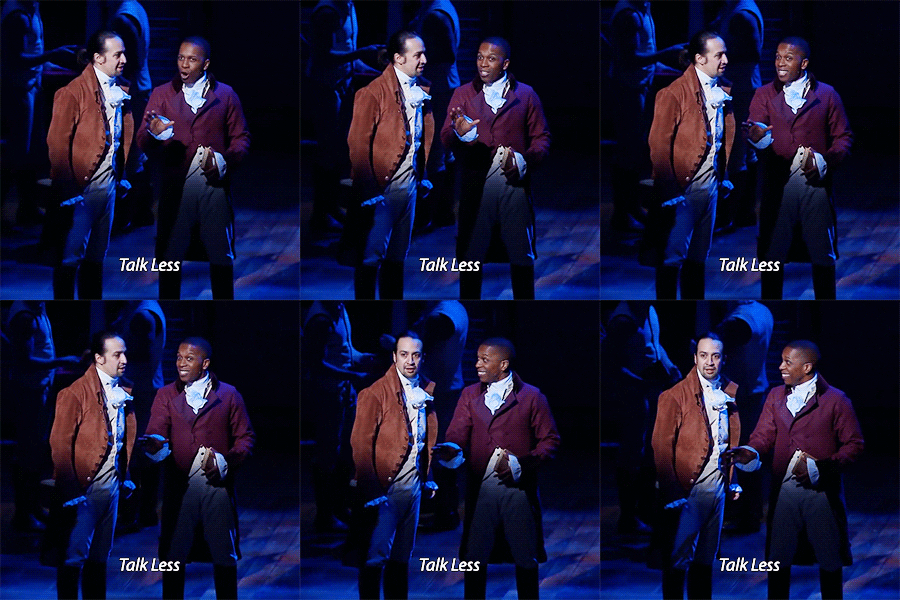
So Reflectors might seem less opinionated than the rest of the group, but that’s just their style. Burr tries to maintain neutrality on all fronts — again, he literally speaks Reflector language when he says he’s “willing to wait for it,” since a Reflector’s strategy is to wait a full lunar cycle before arriving at a decision.
Burr doesn’t feel great about moving fast like Hamilton, doesn’t sit well with the pressure to keep up with others and their non-stop pace. He shares Reflector disappointment at the way things are going and often feels forgotten or left behind by his peers.
But when he takes his time alone to process his own feelings, when he steps away from the hustle and away from the people who don’t get his unique abilities, he can pinpoint what he needs out of life. Burr finds the signature sense of surprise and delight in the love of his wife and daughter Theodosia.
Ironically, I think Burr’s desire to be in the room where it happens and prove himself as a politician is another example of misaligned energy. He’s away from the people who value him and once again trying to keep up a pace that doesn’t work for him, as well as becoming a chameleon whom others don’t always warm to because he’s always changing to suit the situation.
So could this entire tragedy been avoided if our Manifestor Hamilton and Reflector Burr had been able to understand their energy types a bit more fully? The world may never know. 😉
Want to know how your Human Design type can help you live every day with less friction?
Book a 30-minute Human Design Download session and I’ll walk you through the essentials of your chart.
We’ll talk about your type, strategy, and authority, and how you can use these pieces of your esential YOU-ness to make your life easier.
Every single one of us is wired in a specific way to feel our best, and we all have specific cues we can follow to get to that place.
I’ll break it all down for you in simple language and give you actionable ways to work with your design and incorporate it into your daily life — instead of going against the flow with habits that don’t serve you.

TIP YOUR TOUR GUIDE
Like what you’re reading here?
I choose to keep my site ad-free and sponsorship-free, so please consider showing your appreciation by leaving a few dollars in my tip jar.